Losing one or more teeth can make it harder to chew, speak, and smile with confidence. Fortunately, there are different ways to replace missing teeth.
Two common options are a Fixed Partial Denture (FPD) and a Removable Partial Denture (RPD).
So, what is the difference between FPD vs RPD?
The simple answer is that an FPD is fixed in the mouth and cannot normally be removed by the patient, while an RPD can be taken out and put back in by the patient. The right option depends on the number and position of missing teeth, the health of the remaining teeth and gums, bone and bite conditions, and your overall treatment needs.
An FPD (Fixed Partial Denture) is a fixed tooth replacement that is not normally removed by the patient. An RPD (Removable Partial Denture) can be removed and reinserted by the patient. The suitable option depends on the number and location of missing teeth, the condition of the remaining teeth and gums, bite, supporting structures, and your overall treatment needs.
In this guide, we explain FPD vs RPD, how each works, the main RPD parts, RPD design, Kennedy classification, and what to discuss with your dentist before choosing a treatment.
What Is an FPD?
FPD stands for Fixed Partial Denture.
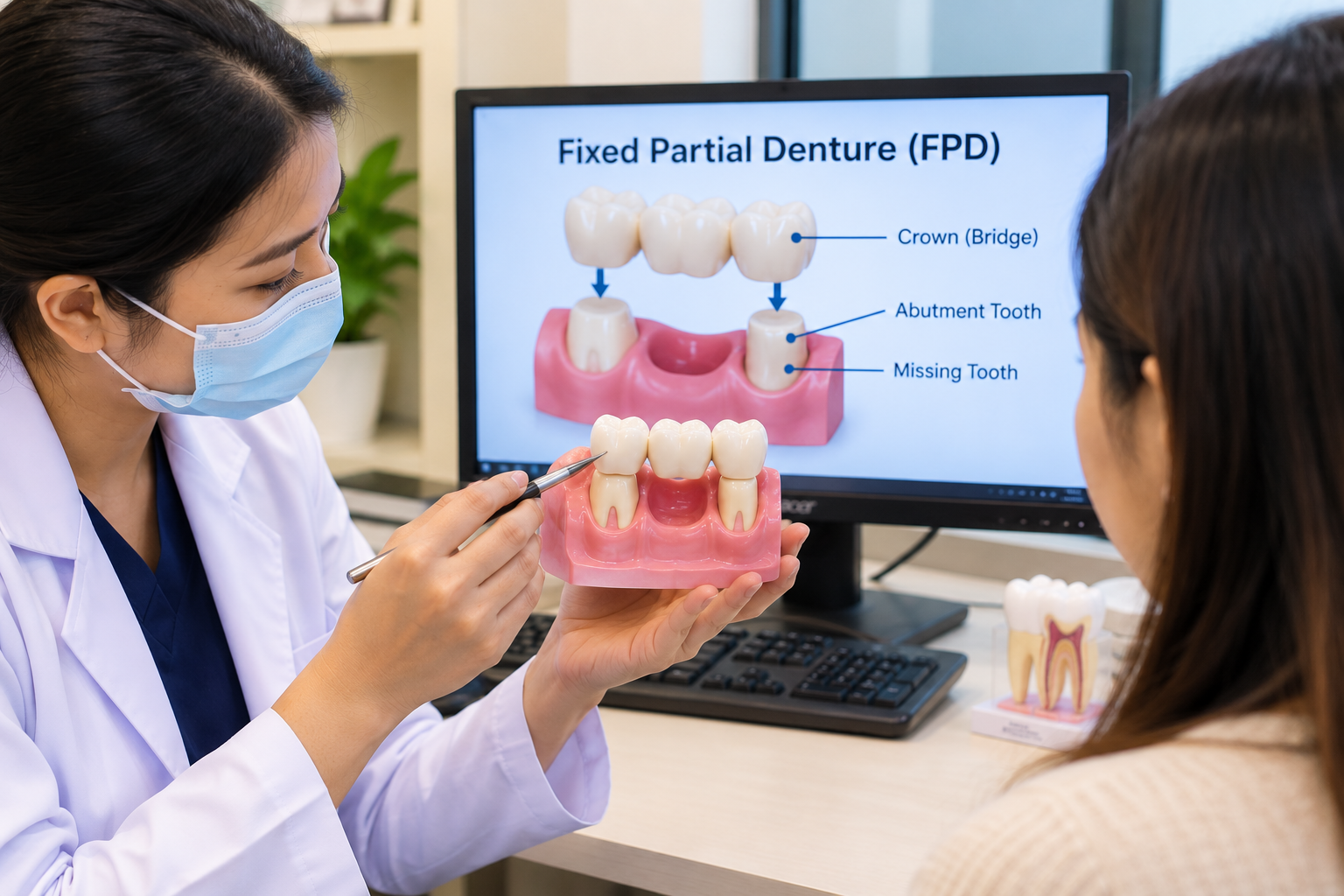
A fixed partial denture is a dental prosthesis used to replace one or more missing teeth. It is attached to supporting teeth or, in some cases, implant replacements and is not designed to be removed by the patient.
A common type of FPD is a dental bridge.
For example, if one tooth is missing and the teeth next to the space are suitable to support a bridge, a dentist may consider an FPD as one treatment option.
The American Dental Association defines a fixed partial denture as a prosthetic replacement for one or more missing teeth that is attached to natural teeth or implant replacements.
How does an FPD work?
An FPD uses supporting teeth, called abutment teeth, or other suitable support to hold the replacement tooth or teeth.
The basic idea is:
Supporting tooth → replacement tooth → supporting tooth
The exact design depends on the location of the missing tooth or teeth and the condition of the supporting structures.
Your dentist will examine your teeth, gums, bite, and the space created by tooth loss before deciding whether an FPD is appropriate.
What Are the Main Parts of an FPD?
Abutment
The tooth or implant-supported structure that provides support for the restoration.
Retainer
The part of the restoration that attaches to or covers the supporting tooth or structure.
Pontic
The artificial tooth that replaces the missing natural tooth.
Connector
The part that joins the pontic to the retainer in a fixed bridge design.
The exact components depend on the type of fixed partial denture and the patient's individual treatment plan.
Types of Fixed Partial Dentures
The type of fixed restoration used to replace a missing tooth depends on the location of the gap, the condition of the supporting teeth, and the patient's overall oral health.
Conventional Fixed Bridge
A conventional fixed bridge replaces a missing tooth by using the teeth next to the gap as support. The replacement tooth, called a pontic, is connected to crowns placed on the supporting teeth. This is one of the common forms of a fixed partial denture (FPD).
Implant-Supported Fixed Restoration
An implant-supported restoration uses a dental implant placed in the jawbone to support a replacement tooth or fixed restoration. It does not rely on neighboring natural teeth in the same way as a conventional bridge. Dental implants are among the tooth-replacement treatments discussed by Dynamic Dental Clinic, with suitability depending on the patient's bone and oral health.
The dentist can assess the missing-tooth area and explain which fixed replacement option may be appropriate for your situation.
What Is an RPD?
RPD stands for Removable Partial Denture.
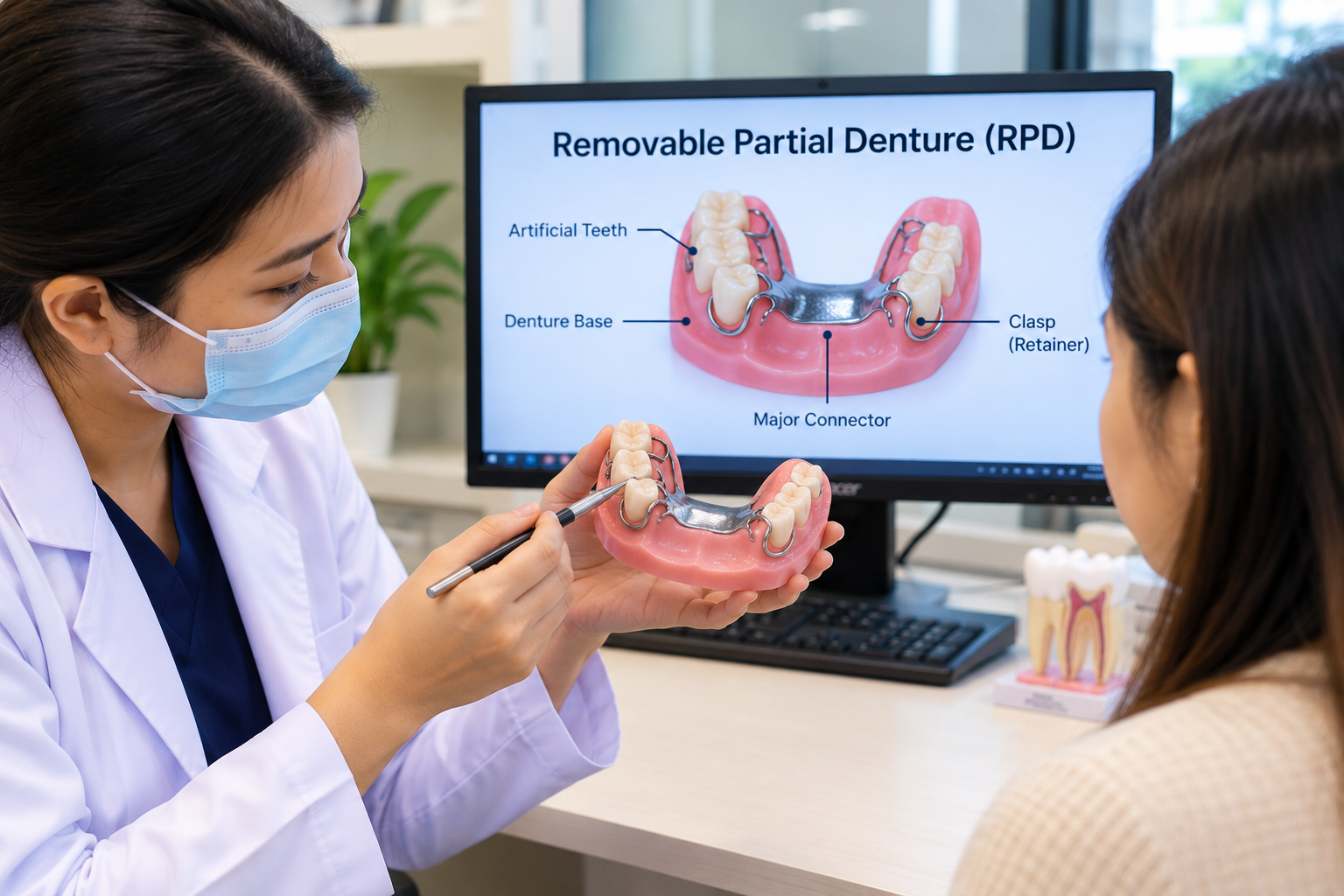
An RPD, or removable partial denture, is a removable dental prosthesis that replaces one or more missing teeth while some natural teeth remain.
Unlike an FPD, an RPD can be removed by the patient.
The American Dental Association describes a removable partial denture as a prosthetic replacement for one or more missing teeth that can be removed and reinserted by the patient.
An RPD may be considered when several teeth are missing or when a fixed option is not suitable.
Depending on the case, an RPD can use a combination of a framework, artificial teeth, denture base, rests, and retainers to provide support and stability.
FPD vs RPD: Main Difference
The biggest difference between FPD and RPD is whether the patient can remove the restoration.
Feature
FPD
RPD
Full name
Fixed Partial Denture
Removable Partial Denture
Removable by patient
No
Yes
Main use
Replacing missing teeth with a fixed restoration
Replacing one or more missing teeth with a removable prosthesis
Support
Usually supporting teeth or implants
Remaining teeth and oral tissues, depending on design
Cleaning
Cleaned while in the mouth
Removed for cleaning
Design
Fixed restoration design
Removable framework and denture design
Common components
Abutment, retainer, pontic, connector
Major connector, minor connectors, rests, retainers, denture base, artificial teeth
Treatment planning
Depends on supporting teeth and structures
Depends on remaining teeth, tissues, tooth-loss pattern, and design
Maintenance
Oral hygiene around the restoration is important
Denture and remaining teeth require regular care
Suitability
Depends on supporting teeth and clinical conditions
Depends on remaining teeth, gums, ridge, spaces, and other factors
There is no single option that is suitable for every patient. Denture treatment planning can consider factors such as the number of teeth being replaced, bone and oral conditions, cost, and individual needs.
FPD vs RPD: Which One Is Right for You?
There is no simple answer to which one is better.
The choice between an FPD and RPD should be based on your individual dental condition.
Your dentist may consider:
- How many teeth are missing
- Where the missing teeth are located
- The health of the remaining teeth
- The condition of your gums
- The amount and shape of supporting bone
- Your bite
- The size of the tooth gap
- The condition of possible supporting teeth
- Your ability to maintain good oral hygiene
- Your treatment preferences
- Your budget and long-term needs
A dental examination is important before choosing a tooth replacement option.The decision is based on clinical examination rather than the name of the restoration alone.
What Is an RPD in Dentistry?
RPD in dentistry means Removable Partial Denture.
It is used when a patient has some natural teeth remaining but also has one or more missing teeth.
An RPD is designed to restore missing teeth while working with the teeth and tissues that remain.
Depending on the case, an RPD may help restore:
- Chewing function
- Speech
- Tooth appearance
- Tooth contact and bite
- Support for the lips and cheeks
However, an RPD must be properly designed and fitted. A poorly fitting removable denture can cause movement, discomfort, or sore areas. If a denture does not fit correctly, a dentist may need to adjust, reline, or replace it.
What Are the Main RPD Parts?
Understanding the RPD parts can make removable partial dentures easier to understand.
The exact parts vary depending on the design, but common components include:
1. Major Connector
The major connector joins different parts of the RPD together.
In the upper jaw, examples may include a palatal connector. In the lower jaw, a lingual connector may be used depending on the patient's anatomy and treatment plan.
2. Minor Connectors
Minor connectors connect certain components, such as rests and clasps, to the major connector.
3. Rests
Rests provide support and help control the position of the RPD.
They are placed on prepared areas of suitable supporting teeth when indicated.
4. Direct Retainers
Direct retainers help hold the RPD in position.
Clasps are one common type of direct retainer.
5. Indirect Retainers
Indirect retainers may help resist unwanted movement or rotation of certain RPD designs.
6. Denture Base
The denture base rests over the area where teeth are missing and supports the artificial teeth.
7. Artificial Teeth
These replace the missing natural teeth and are attached to the denture base.
The American Dental Association's dental terminology also describes the denture framework as the rigid structure that supports denture components and provides functions such as rigidity, retention, and support.
What Is RPD Design?
RPD design is the process of planning how a removable partial denture will support and replace missing teeth.
Good RPD design considers several factors, including:
- Remaining natural teeth
- Missing tooth areas
- Gum and tissue condition
- Jaw shape
- Bite
- Support
- Stability
- Retention
- Appearance
- Patient comfort
The dentist and dental laboratory must work together to create a design that fits the patient's individual oral condition.
This is important because an RPD is not simply a set of artificial teeth. Its framework and supporting components need to work together.
What Is Kennedy Classification?
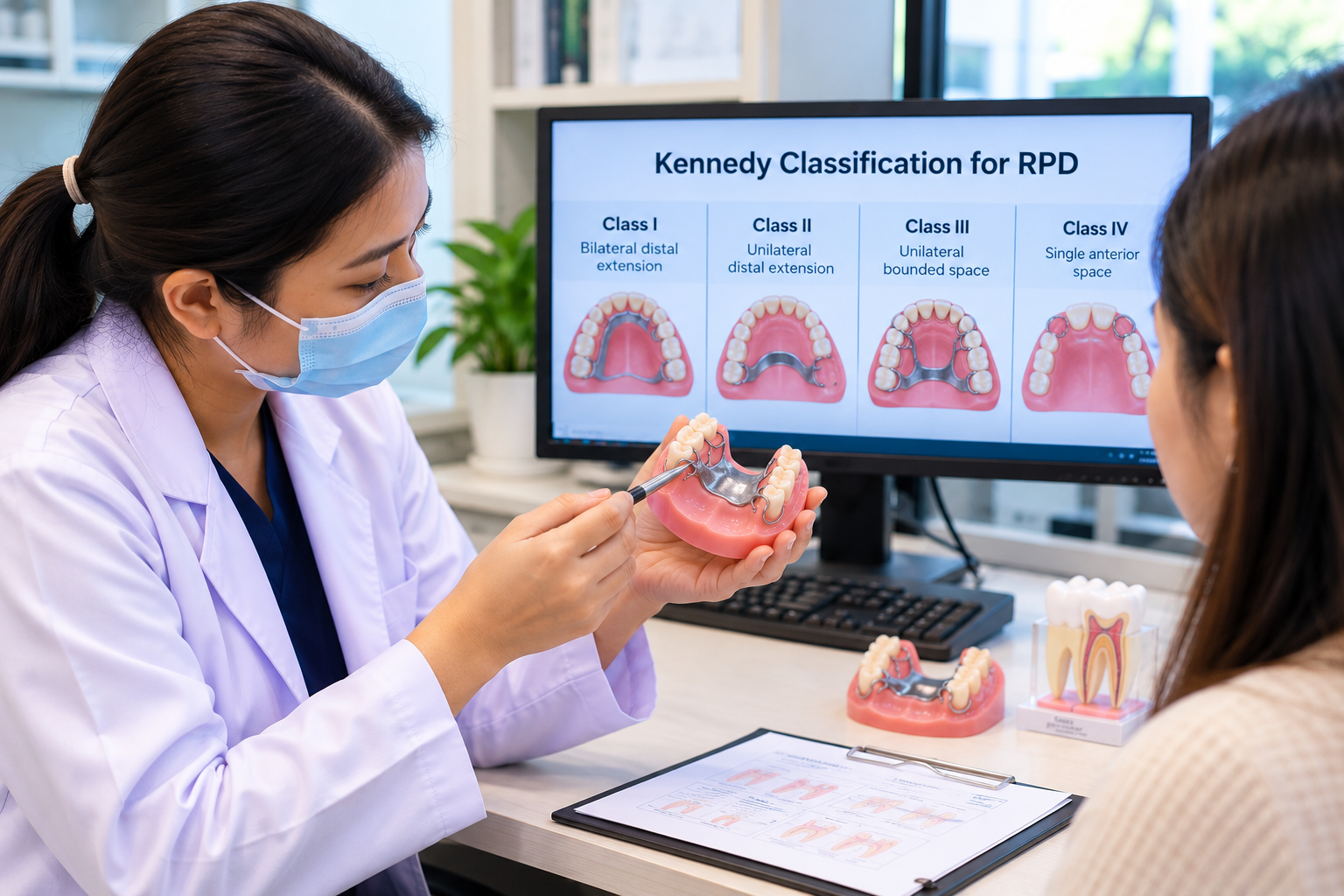
Kennedy classification is a system used in prosthodontics to describe patterns of missing teeth and help with removable partial denture planning.
The four main Kennedy classes are:
Kennedy Class I
Missing posterior teeth on both sides of the dental arch, with no natural teeth behind the spaces.
Kennedy Class II
A missing posterior area occurs on one side of the dental arch.
Kennedy Class III
A missing tooth or teeth are located between natural teeth, meaning there are natural teeth both in front of and behind the space.
Kennedy Class IV
A missing anterior area crosses the midline of the dental arch.
The classification describes the pattern of missing teeth; it does not by itself determine the final RPD design.
Kennedy classification helps dental professionals describe the pattern of tooth loss and plan an appropriate RPD design.
Why Is Kennedy Classification Important in RPD Design?
Different patterns of missing teeth create different support and movement challenges.
For example, an RPD replacing teeth at the back of the mouth may behave differently from one replacing teeth in a space surrounded by natural teeth.
Because of this, the dentist considers the location of missing teeth when planning:
- Major connector
- Minor connectors
- Rests
- Retainers
- Denture base
- Artificial teeth
- Support and stability
This is one reason why RPD design is customized for each patient rather than using exactly the same design for everyone.
FPD vs RPD: Advantages and Considerations
FPD
A fixed partial denture stays in place and is not normally removed by the patient.
FPD: Potential Advantages
- Fixed in the mouth
- Does not need to be removed for daily use
- Can replace one or more missing teeth
- Can restore chewing function and appearance
FPD: Things to Consider
- Supporting teeth must be suitable
- Good oral hygiene is important
- The supporting teeth need to be carefully evaluated
- Treatment may require preparation of supporting teeth depending on the type of FPD
RPD
A removable partial denture can be removed by the patient.
RPD: Potential Advantages
- Can replace one or more missing teeth
- Can be removed for cleaning
- May be suitable when several teeth are missing
- Can be designed for different patterns of tooth loss
RPD: Things to Consider
- It needs regular cleaning
- It may take time to become comfortable with
- It can move if it does not fit or is not designed appropriately
- Remaining natural teeth and gums still require good oral care
The ADA recommends daily cleaning of dentures and emphasizes that poorly fitting dentures may require professional evaluation, adjustment, relining, or replacement.
FPD vs RPD: Care and Maintenance
Whether you have an FPD or RPD, good oral hygiene remains important.
For an FPD, pay special attention to cleaning around the restoration and supporting teeth.
For an RPD:
- Remove the denture as instructed by your dentist.
- Clean the denture regularly.
- Clean your natural teeth and gums.
- Follow your dentist's instructions for wearing and storing the denture.
- Attend dental checkups.
- Tell your dentist if the denture becomes loose, painful, cracked, or uncomfortable.
The ADA recommends cleaning dentures daily and avoiding hot or boiling water because heat can cause dentures to warp.
Can an RPD Replace Several Missing Teeth?
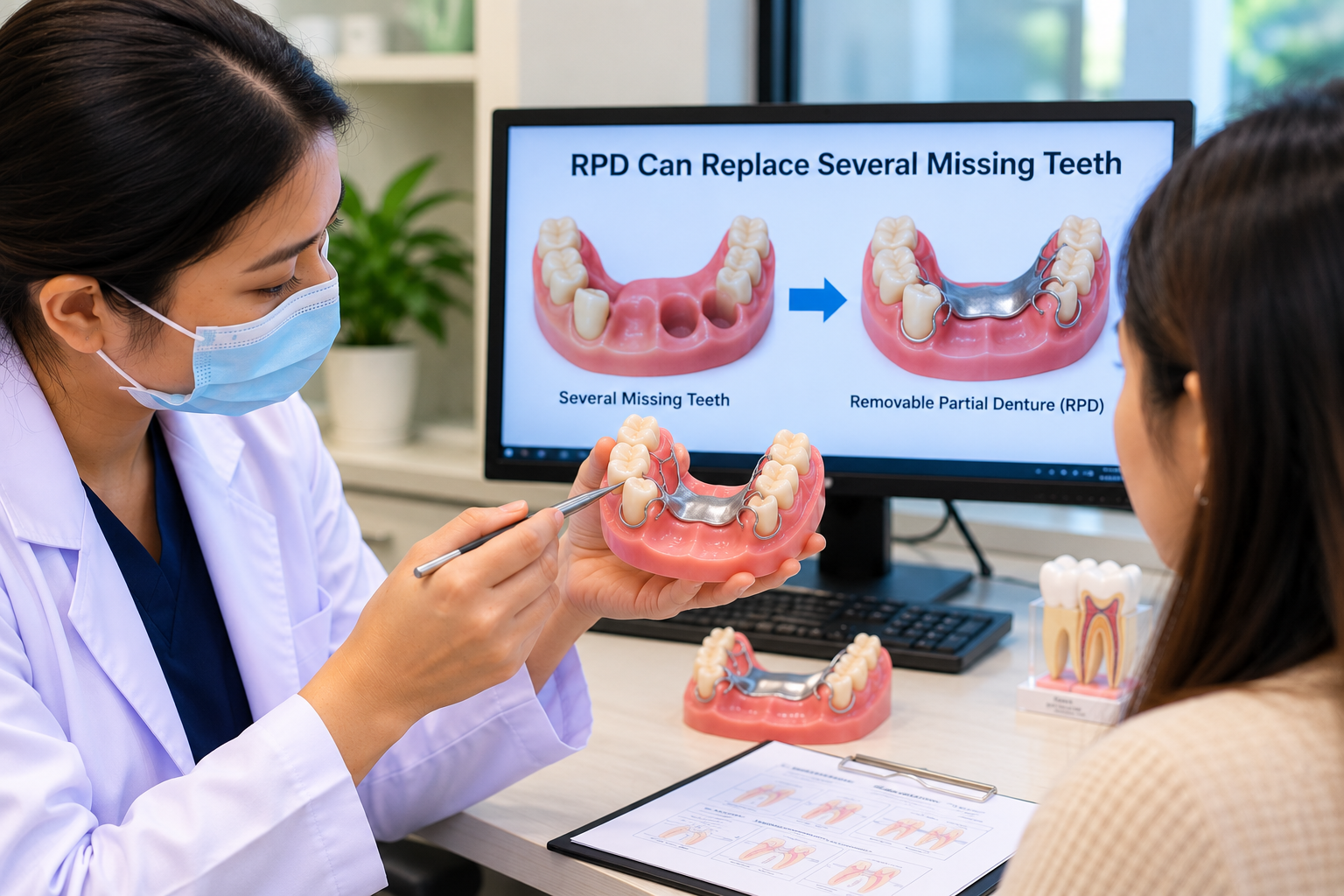
Yes. An RPD can be designed to replace one or more missing teeth.
The design depends on the location and number of missing teeth, the remaining teeth, the supporting tissues, and other clinical factors.
If several teeth are missing, your dentist may discuss different replacement options, such as an RPD, FPDs where appropriate, or dental implants.
The best option cannot be selected from the number of missing teeth alone. A dental examination is needed.
FPD vs RPD vs Dental Implant
Option
Fixed or removable?
Main support
Key consideration
FPD
Fixed
Supporting teeth or suitable implant support
Requires suitable supporting structures
RPD
Removable
Remaining teeth and oral tissues, depending on design
Requires appropriate design and maintenance
Dental implant restoration
Usually fixed
Dental implant
Requires evaluation for implant treatment
These options are not interchangeable for every patient. A dentist needs to evaluate the missing-tooth area, remaining teeth, gums, bone, bite, overall oral health, and treatment goals before recommending an option.
Can an FPD Replace More Than One Tooth?
Yes. A fixed partial denture can replace one or more missing teeth when the supporting conditions are suitable.
The dentist needs to check the teeth or implants that would support the restoration.
The location of the missing teeth, the health of the supporting teeth, bite, and other factors all affect treatment planning.
FPD vs RPD: Frequently Asked Questions
Is FPD better than RPD?
Neither treatment is automatically better for every patient. FPD and RPD are different treatment options, and the appropriate choice depends on your teeth, gums, missing tooth pattern, bite, and overall treatment needs.
What does RPD stand for in dentistry?
RPD stands for Removable Partial Denture. It is a removable prosthesis used to replace one or more missing teeth when some natural teeth remain.
What does FPD stand for?
FPD stands for Fixed Partial Denture. It is a fixed prosthesis used to replace one or more missing teeth.
What is the main difference between FPD and RPD?
The main difference is removability. An FPD is fixed in the mouth, while an RPD can be removed and reinserted by the patient.
What are the parts of an RPD?
Common RPD parts include the major connector, minor connectors, rests, direct retainers, indirect retainers, denture base, and artificial teeth. The exact components depend on the individual RPD design.
What is Kennedy classification?
Kennedy classification is a system used to describe common patterns of partial tooth loss. It has four main classes and is commonly used when planning removable partial dentures.
How do I know whether I need an FPD or RPD?
A dentist needs to examine your teeth, gums, bite, missing tooth spaces, and supporting structures before recommending a treatment option.
Can an RPD be removed at night?
Removable dentures are often removed for cleaning and rest, but the exact wearing instructions should come from your dentist because recommendations can vary by patient and treatment.
Can an RPD feel loose?
An RPD may move if it does not fit properly or if changes have occurred in the mouth. If your denture feels loose, causes sore areas, or becomes uncomfortable, have it checked by a dental professional.
What is the difference between FPD and RPD in terms of cleaning?
An FPD remains in the mouth, so cleaning focuses on the restoration, supporting teeth, and surrounding areas. An RPD can be removed for cleaning, while the remaining natural teeth and gums also need regular oral care.
What factors affect FPD or RPD treatment planning?
Treatment planning may consider the number and location of missing teeth, the condition of remaining teeth and gums, bite, supporting structures, oral hygiene, and the patient's treatment needs.
Can the same patient have different tooth replacement options?
Yes. Depending on the location and pattern of missing teeth, a patient may have more than one possible treatment option. A dentist can evaluate the mouth and explain which options may be appropriate.
Dental Care for Missing Teeth in Lalitpur
If you have missing teeth and are considering a fixed partial denture or removable partial denture, a dental examination can help you understand your options.
Dynamic Dental Clinic provides Fixed Partial Denture (FPD) and Removable Partial Denture (RPD) services as part of its restorative dental care.
The clinic is in Lalitpur, so patients from areas such as Kumaripati, Pulchowk, Jawalakhel, Sanepa, and nearby parts of Kathmandu Valley can seek an evaluation for missing teeth and discuss suitable treatment options.
Do not choose an FPD or RPD based only on an online comparison. Your dentist should examine your oral health and explain the available treatment options for your specific situation.